


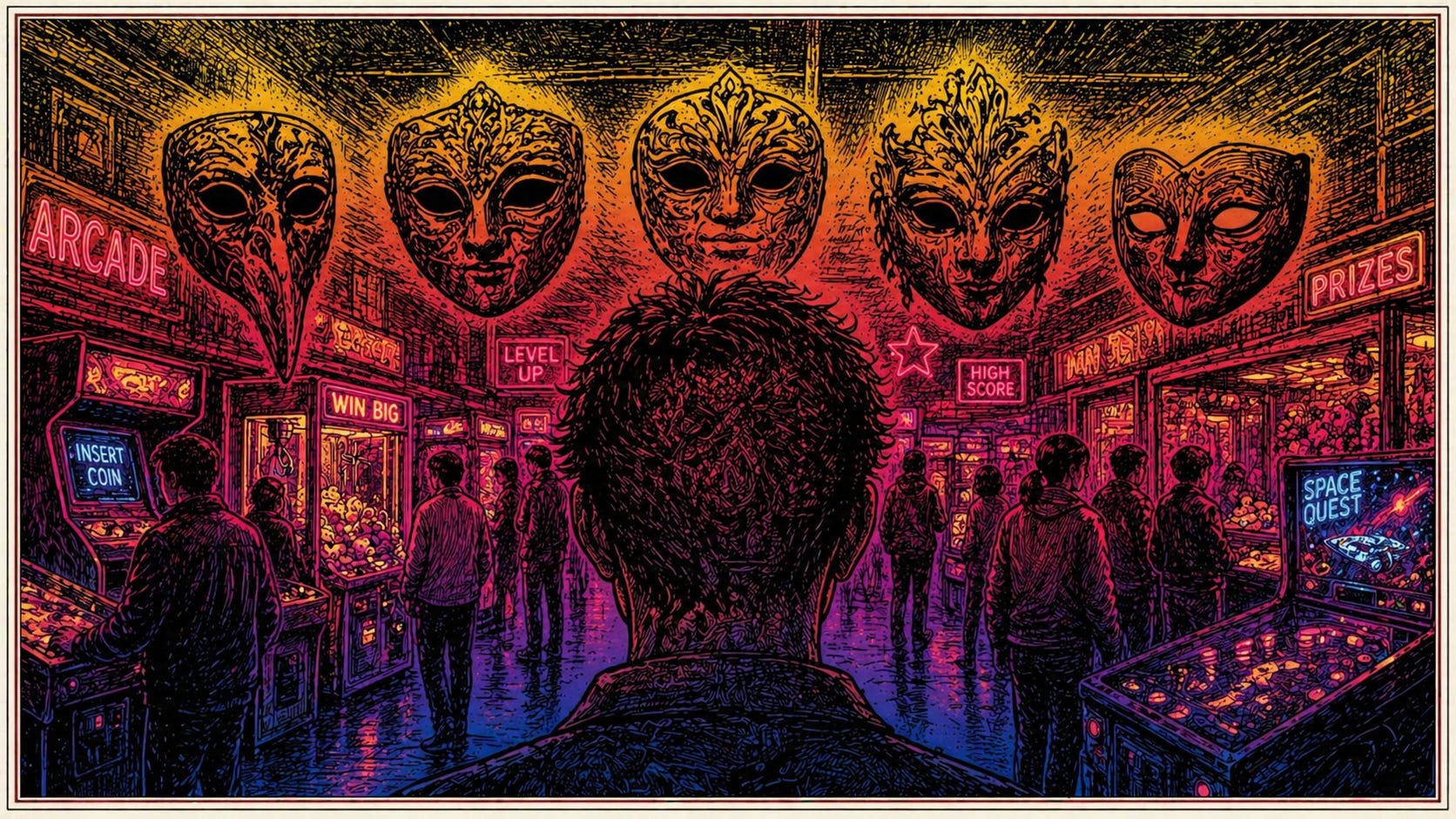
I’ve long had a tenuous relationship with social media. Sure, I’ve interacted with it—mostly in the form of an intuitive drive for creative pursuits, knowing that whatever lay in front of me would involve a public-facing necessity—but it was distanced from actually putting myself in front of the social sphere. The root of my disdain didn’t lie solely in social media, but in the persona. Now that my journey coheres within and without, I’ve returned to where individuation typically starts, to face the mask that’s been shed.
I. Persona-Revolt
The persona is an individual’s interface layer with the general public; it’s the outer mask worn to the world, and—especially in the West—mostly takes on performance-driven appearance such as professional accolades, job role, and degrees.
While this is a necessary adaptive aspect of the psyche, identification with the persona as the totality of the personality will create a shallow, performance-driven, non-authentic personality. It also happens to be something that can signal the opposite of what is true, intoxicating the individual themselves into believing it to be true.
The necessity to present oneself through a persona was something that, until recently, I couldn’t accept. To express my rich inner life—the depth of experiences, the breadth of observation, the dense symbolic imprint of dreams, the large brushstrokes of emotions and intuitions—through an online presence seemed outrageous. Any public portrayal less than felt actuality just seemed too hard for me to accept. So, I just refrained from use.
Though, unless I decided to stay in complete solitude, there was no avoiding the public-facing identity. As I discovered more about who I was and wanted to become, my old persona title started to increasingly feel more distant. I had a distaste for being ‘the accountant.’ So, I fled from persona completely, moving through each mention of it as a moment of discomfort.
My aversion to persona turned into a proactive journey: aim as high as you could imagine, wield intuition, and discover what your actual quest was; move beyond the day job.
Once I found something important to me, I knew that I could return to the persona with a healthier relationship.
Until then, the persona was held in suspension, prepared for deployment if necessary during those uncertain times, but rejected and shed when not in use.
Dreams kept me on the path, synchronicities pushed me when doubt crept, and I was on my way.
II. Higher Orientations
My official entrance into Carl Jung’s corpus was The Undiscovered Self.
In the lead up to and through World War I, Jung was confronted by the darkness within the individual and its manifestation in the situation of the collective. The book tackled the themes again, this time in the aftermath of World War II, when the tension of the psyche was arguably more fraught with turmoil than at the cusp of WWI.
As I moved through the contents of the book, the information buzzed and reverberated through my body as if I had just come upon a chest of information I was meant to find, and I happened to find it at the exact moment that I could absorb it. Jung displayed his psychology, which facilitated the navigation of a self-discovery and inner growth, in a way that I found wonderfully different from the modern therapeutic approach.
It was exciting. But also infuriating.
The barbarism Jung wrote about in 1956 had not been resolved, nor did our modern culture seem to value Jung’s proposed resolution in the slightest.
Jung’s solution resonated quite heavily with me, but his method isn’t presented as an exact science (of course, no psychology is because the human mind is not), and the scientific tilt of the twentieth century made Jung’s method seem to the public, wishy-washy at best.
Today, the story is different. I see the unconscious coordinating toward these ends with a surge in the methods available toward psychospiritual progression.
In many ways, I see writing fiction as my ability to contribute to this at scale.
One thing stories do—when done well—is deliver a compressed packet of latent psychological and spiritual material that communicates a moral truth, which expands a reader’s ability to interface with specific non-physical patterns (archetypes).
In the way math is an abstraction that when applied creates unbelievable feats of the material world, I think story is an abstraction that when applied can create unbelievable feats of the moral & behavioral world; the deeper the story, the more impactful and the more a culture is predicated on it (mythological and religious stories).
When I was studying leadership as I was becoming a manager in my corporate life, I found that while nonfiction helped me accumulate rules to apply and consciously wield, fiction allowed me to excavate undiscovered pathways of behavior through character.
Writing story allows me to investigate cultural, moral, and behavioral hypotheses for individuals, explore them, and present what I find in an entertaining, meaningful, and interesting way.
All said, I’ve come to understand that no matter how consciously articulated your highest orientation is, it cannot function outside of a hierarchy of values at unreachable heights. I will go deeper into this line of inquiry in the future.
III. Feeling My Way Back
I’ll be honest, I felt this in my heart before I could explain the above. There was a moment where it just… clicked. After my wedding, I had a strong intuition to write a novel, and every step of the way has reaffirmed the feeling more strongly and specifically.
That certainty has granted me a beautiful anchor of clarity every day, which when established, invited an onslaught of questions that helped me settle into becoming a fiction writer in a way unique to me.
The fiction-related questions have been mostly settled. I have a solid structure of studying, continuous improvement, and creative output with a good sense of where I’m going, what I’m writing, and the pipeline of ideas I’m pursuing.
With all that in place, my dreams and intuition guided me back to what has been shed and its natural habitat: the persona and social media.
The message? It’s time to bring the journey into the social world in full force.
I’ve been wrapped in this question for a good portion of the first quarter of the year:
What social media games should be played, why, and how should they be approached so that the persona is a container for authentic output that serves the highest aim, while avoiding pitfalls and misuse?
Here’s how I’ve practically tried to answer this question.
IV. Persona & Social Media
Without self-reflection, all that sits behind the persona stays hidden, and can therefore become a massive detriment to the growth of the individual; one cannot grow beyond what the mask portrays without the recognition that they are not the mask.
It’s why something as psychologically ‘simple,’ as the persona can become so dangerous.
But the persona contains more utility than harm. Social settings would be far too complex and challenging without it. Human beings are so complex that dropping them in predefined buckets makes it easy to set them aside as understandable.
“Jeff in the bookstore,” evokes a vague, grainy image of a man in a bookstore, maybe some guy you know named Jeff, standing in the first bookstore that came to mind.
“Jeff the tax attorney in the bookstore,” evokes an image of a man, what he’s wearing, a better guess as to which aisle he’s browsing, his personality, and other details that you may have associated with the persona label tax attorney.
That also tells us yet another danger: people can misuse the persona to display themselves as someone they’re not but want the public to see them as. Search no further than social media to find spruced-up personas, allowing a shallow person to glow in glamour; typically as a cover for deep hurt and past pain (interesting dream imagery in the footnotes if that’s your thing).1
I’ve learned that the best way to approach social media is to use the platforms as containers for authentic expression, aligning my output with each platform’s best-positioned function while ensuring that, above all, it serves the highest-order goal. Knowing what purpose the platforms serve helps ensure the algorithm doesn’t take hold and alter me as a creator.
That’s the frame through which I approach the game of social media, and it’s one of the reasons I like Substack.
Substack was the first social media where I felt some semblance of a home, in part because it doesn’t feel like other social medias (to some extent).
I enjoy its capability to add depth2 and nuance.
Long form spoken content gives me similar depth/nuance but through the spoken word, though like Substack, it’s time consumption is at times hard to justify in the face of the perceived benefit. I’ve experimented with a new form of YouTube video where i just take a seed or a question and just speak on it. This allows me to explore some nascent ideas casually, to see if they can become anything bigger.
I’ve had some success with shorts content, specifically TikTok. I’ve come to understand why it’s a popular place for writers. It’s easy to craft a short video, and then get back to writing. BookTok makes sense to me on another level, now.
I’ve also found that TikTok has been the most healthy for me in terms of psychological development with the persona. Creating something and putting it on social media where I know people won’t see it avoids the actual work of stepping into a new persona. TikTok is by far the most exposed I’ve been with my new persona; I have family, friends, and friends of friends spread all over TT. It’s been great to see those irrational fears expelled when I was greeted by support.
It also takes the least amount of time to produce, but still allows me to serve the fiction.
TikTok has its dangers, which is why I have a hyper-conscious approach to it, up to the principles, down to the containerized time blocks for which I produce videos.
It may seem obsessive to define persona and the social media model in such a way—and maybe it is—but for me, since it’s something I need to interface with it, it’s important I have a conscious procedure of interaction, because I know the alternative is one where the unconscious controls it. I know that it will continue to evolve, and that’s why the artist gets the final say, so that I can stay responsive to any dynamic movement.
For now, the aim is simple: serve the work and let the public form evolve without letting it take over.
For the full extent of my social accounts, you can check them out here.
Thanks for reading. Take care!
Dom
I had quite the remarkable dream image to describe this:
“I’m at an arcade and I’m in a section on the right side of the arcade that’s lined with games where you can win money and I see [popular kid from high school] playing a game. We start chatting and he’s playing with a lot of money and it’s a game to win electronic prizes.*
I get an thematic visual introduction of the most feared, revered, and successful player in the arcade: a shiny golden knight. I get the sense that he’s the most powerful knight playing the game; the comparison in the dream is to The Mountain from GOT. His helmet is maybe 3 feet tall—a glimmering gold with an intimidating expression. It protects him and is part of what makes him special. The dream shows me a flashback so that I get to see how he got the mask. A scene plays out when he was a child:
His father was seated at the front of a dojo and called his son up in front of the entire class of children. His son, head down, eyes low, nervously marched to the front and faced the class. The father took a cauldron of boiling water and poured it all over his son’s head until it morphed and deformed into a specific shape. It caused the knight immense pain—physical and emotional.
Now it’s modern day, I see the golden knight without his helmet; he approaches a wall that will give him access to the arcade but the only way into the arcade, is to take the gold helmet off a pedestal and put it on his head. The helmet is the right shape to fit the deformity, and it opens the wall and lets him in (he cannot enter the arcade (social media) without the mask). I glimpse him without the mask, and his head and face are hideously deformed, gelatinous and a head shaped like a football, jagged on the top instead of round. The message and feel of those in the arcade are unanimous: he is the most well-known and revered because he wore that glimmering mask atop the trauma from his past, but because of it, he has not a single friend, only sycophants, subordinates and malcontents.”
Be careful which part of yourself the mask is worn upon…
*Note that there is another scene after this, but the imagery is inseparable from the specifics of a person, so I won’t include it for privacy sake.
Depth can have a danger, too. One of the first dream sequences on persona showed me this in a relatively direct way. Here’s an entry from the dream scene: “There is a class on the persona. The dream literally says: “this is a persona class.” The teacher takes a long sword, stands on the desk, and reveals words written (painted?) In red (blood?) on the blade that say: ‘Brooding Persona.’ The teacher falls over and dies.” The dream showed me that if you present yourself through a brooding mask—signaling a depth, pain, and alluding to hidden sadness—you damage the very inner function that could teach you a truer public form.