


I had no idea what I wanted to do with my life and no idea how college was going to help me figure it out. And here I was spending all of the money my parents saved their entire life. So, I decided to drop out and trust that it would all work out ok. It was pretty scary at the time but looking back it was one of the best decisions I ever made.
This was part of Steve Jobs’ 2005 Stanford commencement speech.
Dropping out allowed him to follow his intuition and curiosity without imposed college requirements, leading him to a calligraphy course which at the time seemed like a pointless endeavor.
That was until 10 years later when he was working on the Mac. The skills came back to him and allowed him to build beautiful typography into the Mac computer; maybe not that pointless after all.
Some might claim Jobs was merely mythmaking—building the romantic story that led to the creation of the first Apple computer. Regardless of what he was doing, I take him at face value, and I think there’s an eternal lesson in that story:
Of course, it was impossible to connect the dots looking forward when I was in college, but it was very, very clear looking backwards ten years later. Again, you can’t connect the dots looking forward; you can only connect them looking backwards.
He finishes with simple but deep wisdom: you must trust in something when you’re led off the well-worn path because it’s hard to know where interest and intuition will take you.
What might seem like a reckless decision—dropping out of college, sleeping in friends’ dorm rooms, and taking unusual classes—might also be the greatest thing you end up doing.
I think the interest that led Jobs was an intelligence of its own. While this intelligence is called many things, I’m going to discuss the one I believe to be most transferable across culture, religion, or spiritual practice given its psychological origin.
The Self
There’s a core aspect of Jungian psychology called the Self.
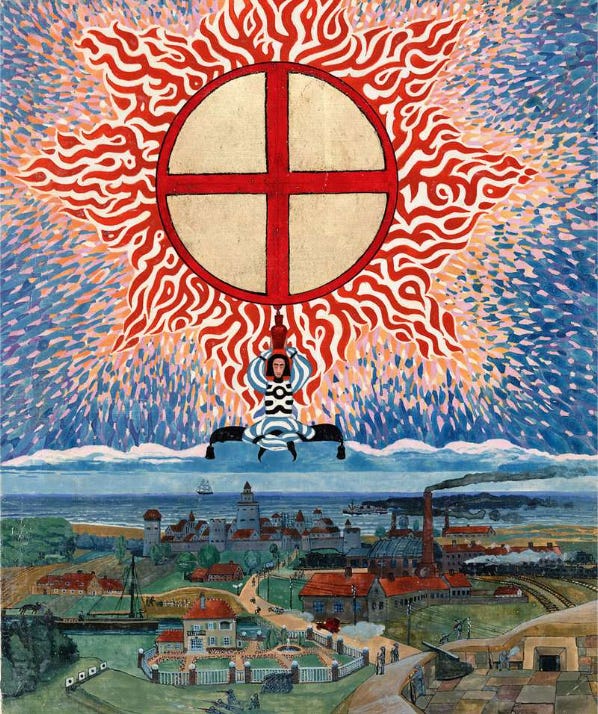
The Self is not only ‘self’ as in ‘yourself,’ your ego, or your scope of consciousness. Self is all of you and your future potential (conscious and unconscious). It’s the totality of the psyche, including both actual and latent aspects; it acts with a goal-directed bend as an organizing center toward your highest possible actuality.
It’s a weird thing. There’s something in (around?) us that not only contains who we are, but all that we could be.
This is the Self.
It’s that which calls forth with an invite to become a better you; the voice that whispers when you’re at a crossroads; it’s that subtle feeling that tugs when you betray a promise you made to yourself or warns when you are about to transgress.
I think Self is an intelligence that pulls you toward certain interests.
Why is it that some people are fascinated by insects, yet others are petrified by them? What is dictating that interest? Something is pushing and pulling people in different ways. It seems to manifest with a probabilistic knowledge of where your ideal future lies, hinting at what journeys and pathways get you to those unseen places of paradise.
I’m giving this Self a lot of power, yeah?
Maybe not enough.
Jung likened the Self to the imago Dei, the inner god-image, and even wrote quite deeply trying to understand if Christ was a symbol of Self, or Self the inner symbol of Christ.1
The stories of a human god, or a son of God, are plentiful. I won’t digress into all the different instances. The important notion is that these human god figures take the imparted knowledge from the divine source, interpret it in different ways (some the same), and implement learnings into the world.
Where does Steve Jobs fit into this? Read closely, one might ask, “Are you telling me Steve Jobs is the son of God?”
No, the point is not that Steve Jobs is a god. The point is that the intelligence that he trusted in, which led him down his profound path, is likely available to everyone.
I find that most people have many different words for speaking about this same intelligence. In the context of the Self, it’s essentially a psychic container through which God makes itself manifest.
What’s striking is that some brilliant post-enlightenment thinkers saw this too; that something God-like imparted intelligence and direction onto them.
The gift of mental power comes from God, Divine Being, and if we concentrate our minds on that truth, we become in tune with this great power.2
~ Nikola Tesla
While I think the path is available to everyone, there was a point in my life where I didn’t hear or see its signals (consciously, at least). Ten years ago, I would have called this nonsense. Not least because I never had conscious access to or felt it. My speculation is that through a commitment to spiritual/psychological ascendence the beckoning begins.
What must not go unnoticed is that the future call can come from an evil place if that’s where a person’s ‘ideal’ future lies. If an individual is after destruction, the trajectory of the call seems like it can guide toward those ends.
This can all seem so abstract. If I were to try to make sense of it with available scientific theory—a science fiction angle—this might be something like the attempt of your highest probability ideal-future trying to retrocausally influence present action through some type of quantum entanglement of present-you with ideal-future-you.
Since we can’t currently know for certain what this intelligence is or all the ways it presents itself, I will try to bring the divine into the mundane by answering the following questions.
What do these signals feel like? How do we differentiate these signals? How can one glean insight as to where they walk on the path between good and evil?
Call
What does the call, something like a spiritual summons, feel like?
I think the answer can only be cultivated individually. I cannot say in full how it looks for someone else, though we can pull from observations of others.
It can come as intuition, dreams, feeling, interests, and strong sense perception.
In my case it started with dreams. The dreams granted me information about the current state of things in my life, with a notion of required change to ascend beyond current state. The more I respected the dreams, recorded them, and interpreted them, the more the dreams returned with higher resolution and more depth.
I get feelings of energy toward a given pursuit, interest, or idea. There are times in my life where certain things are more interesting than others. Where I am compelled to move forward and work on something over something else. When the time for the given thing ends, it’s as if the energy is drained from the specific topic and working toward that endeavor is a slog.
I’ve found though that this needs to be listened to acutely, differentiated from impulse.
Practically speaking, I deal with this via dialogue. I sit down in my daily journal session, and I ask myself if it’s something I really want. If the answer I come to after some thought and feeling is “yes,” then I will build time and space for it in my life.
Sometimes, that pull feels stronger than the others. I know that something is core to who I am when the dreams, interests, curiosity, energy, motivation, and intellectual draw all point in the same direction.
The last time this happened, it brought me to write fiction. The mysterious coordination was ever-present as I was drafting my first novel. All the technology, societal systems, and themes I contemplate on The Frontier Letter served as world-building pillars to the story. Whether some unconscious plan playing out without my conscious foresight, or my mind grabbing onto what I knew, I cannot say.
When following the intelligence, it’s not exactly clear where the road leads. Starting The Frontier Letter years ago did not start as a call to write fiction; yet I was led to it. I found I love doing it and it’s the primary career path I want my life to serve.
It’s unfortunate for the risk-averse part of us that the call doesn’t come with an idea of where it leads. But it’s fortunate for the part of us that seeks adventure.
It’s as exciting a prospect as it is a terrifying one.
Like Jung said:
Individuation means becoming a single, homogeneous being, and, in so far as ‘individuality’ embraces our innermost, last, and incomparable uniqueness, it also implies becoming one’s own self. We could therefore translate individuation as self-realization.
But like Jung also said:
Every step forward along the path of individuation is achieved only at the cost of suffering.
And
He who can risk himself wholly to it finds himself directly in the hands of God, and is there confronted with a situation which makes “simple faith” a vital necessity; in other words, the situation becomes so full of risk or overtly dangerous that the deepest instincts are aroused.3
I think that for this reason, having some conscious recognition of what sits at the top of the hierarchy of aims is helpful. It’s at least one reason why religious structures are useful. But I think it’s possible to do things you love in service of others without adherence to a religious structure. Someone’s ultimate aim can be oriented in a manner that is good for them, their family, community, and society all at once without conscious definition or adherence to any predefined structure.
From this, the signals flow downstream.
Being broke, dropping out of college, sleeping on dorm room floors, and taking pointless courses probably seemed like madness from the outside; no one could see what Jobs felt. No one, not even Jobs, knew where it would lead.
It’s why faith is a requirement.
People can listen to you, they can see your passion and even see you acting out what you say you’ll do, but they cannot see the unique way the eternal intelligence manifests to you.
While Jobs was a special person, I think we all have that specialness available to us, too.
It’s just up to us to listen, act, and give ourselves and the call the respect it deserves so that as we walk our paths, we do so without falling into unnecessary peril, and bring forth a little paradise in our corners of the world.
Believing that the dots will connect down the road will give you the confidence to follow your heart even when it leads you off the well-worn path, and that will make all the difference.
~ Steve Jobs
Until next time, take care of yourselves, everyone.
Dom
Didn't expect this take. 'You can't connect the dots looking forward' is so tru.
Loved this — and it landed at exactly the right moment for me.
Are you familiar with the work of Italian sociologist Ulisse di Corpo and his concept of syntropy?
Quick GPT explainer:
'Entropy is the tendency of systems to drift toward disorder and energy dispersal over time. Syntropy is essentially the opposite framing — a tendency toward increasing order, coherence, and organisation. Where entropy describes “things fall apart unless you add energy,” syntropy points to “under the right conditions, things can self-organise into more structured, life-like patterns...
Essentially Ulisse framed Syntropy as a guiding energy arriving from the future, as opposed to entrophy, a decaying energy acting in the past.
He did a fantastic pod with Tom Morgan of Leading edge - well worth your time if your not familiar with his work :)
https://open.spotify.com/episode/66rmFw6gzQVQs1klCT06P3